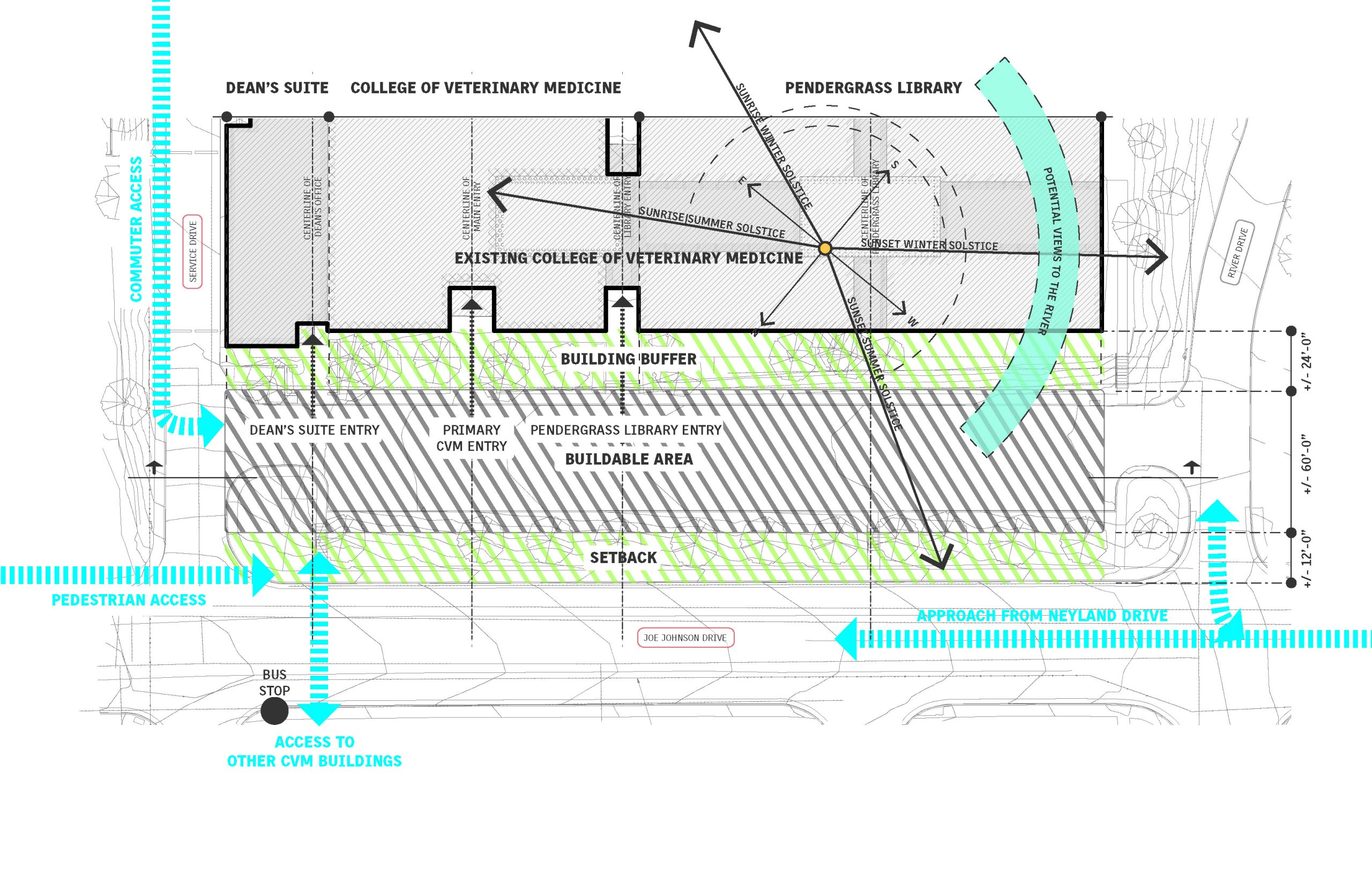
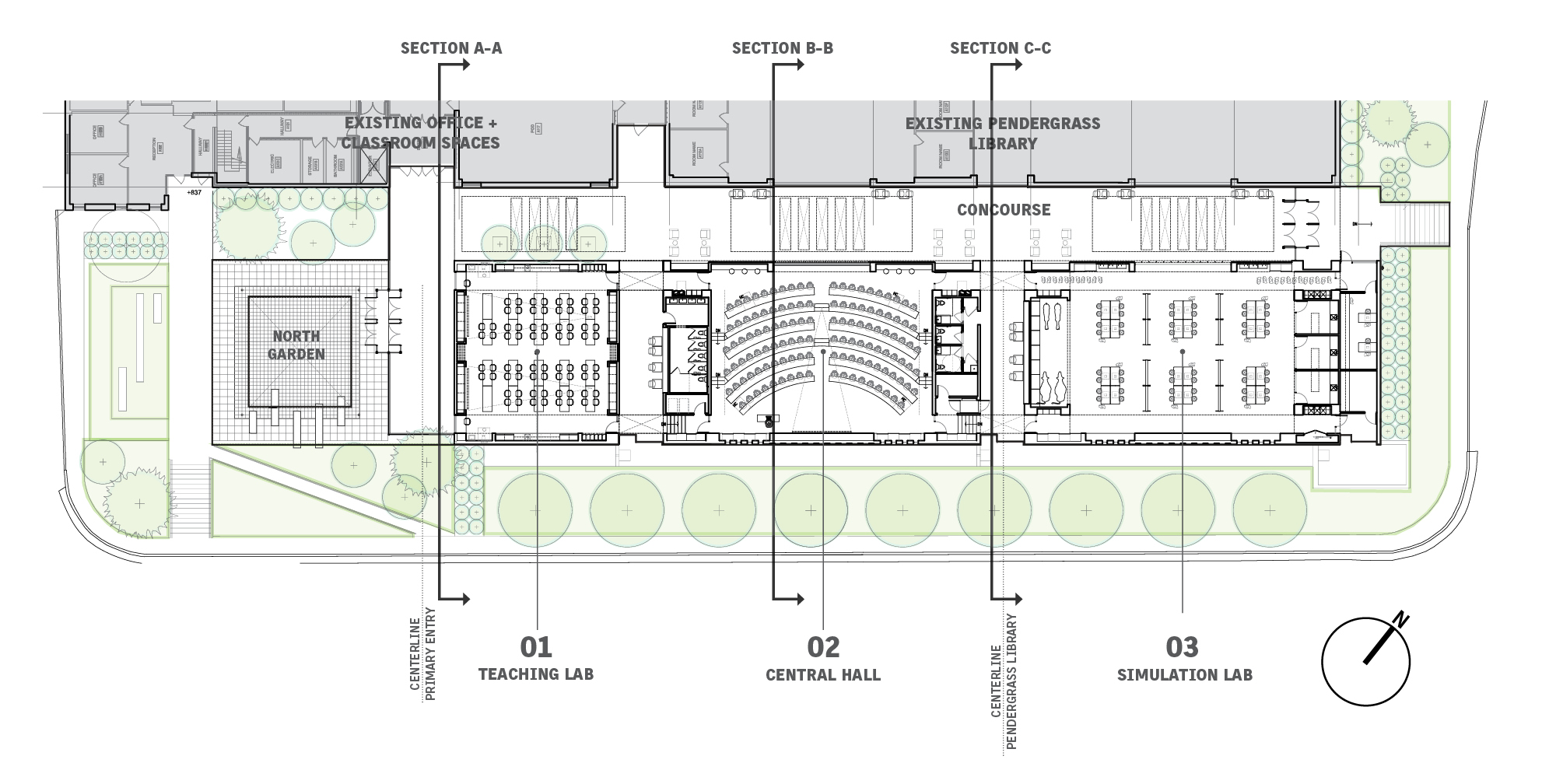
As one of the top schools of Veterinary Medicine in the country, the University of Tennessee desired an expansion to their existing 1976 facility in order to provide a state-of-the-art Clinical Skills Simulation Laboratory, two flexible Teaching Labs, and a 130-seat tiered auditorium-style “Central Hall” that provides lecture space for first and second-year students. The design team was tasked with utilizing the last remaining open space on the College of Veterinary Medicine’s site.
While addition’s main function is to provide new teaching spaces, it also serves as the new “front door” to the College of Veterinary Medicine and the adjoining Pendergrass Library. Programmatically, the building consists of three primary “rooms,” each separated by a central Concourse that provides circulation and collaborative space, while doubling as a new Reading Room for the Pendergrass Library. Access to these rooms is provided from smaller quiet study spaces between the Concourse and the new teaching spaces. Their entries are punctuated by north-facing skylights that flank each side of the mechanical spaces.
The addition efficiently occupies the tight constraints of the 50’-0” x 300’-0” site and was designed and to allow the existing facility to remain operational during all phases of construction. The exterior material palette pulls from the original historic palette found on the campus of the University of Tennessee Institute of Agriculture. Brick, limestone, and terracotta materials clad these iconic structures. With limestone and terracotta noticeably absent from the original building, these two materials serve as the primary palette for the new addition.