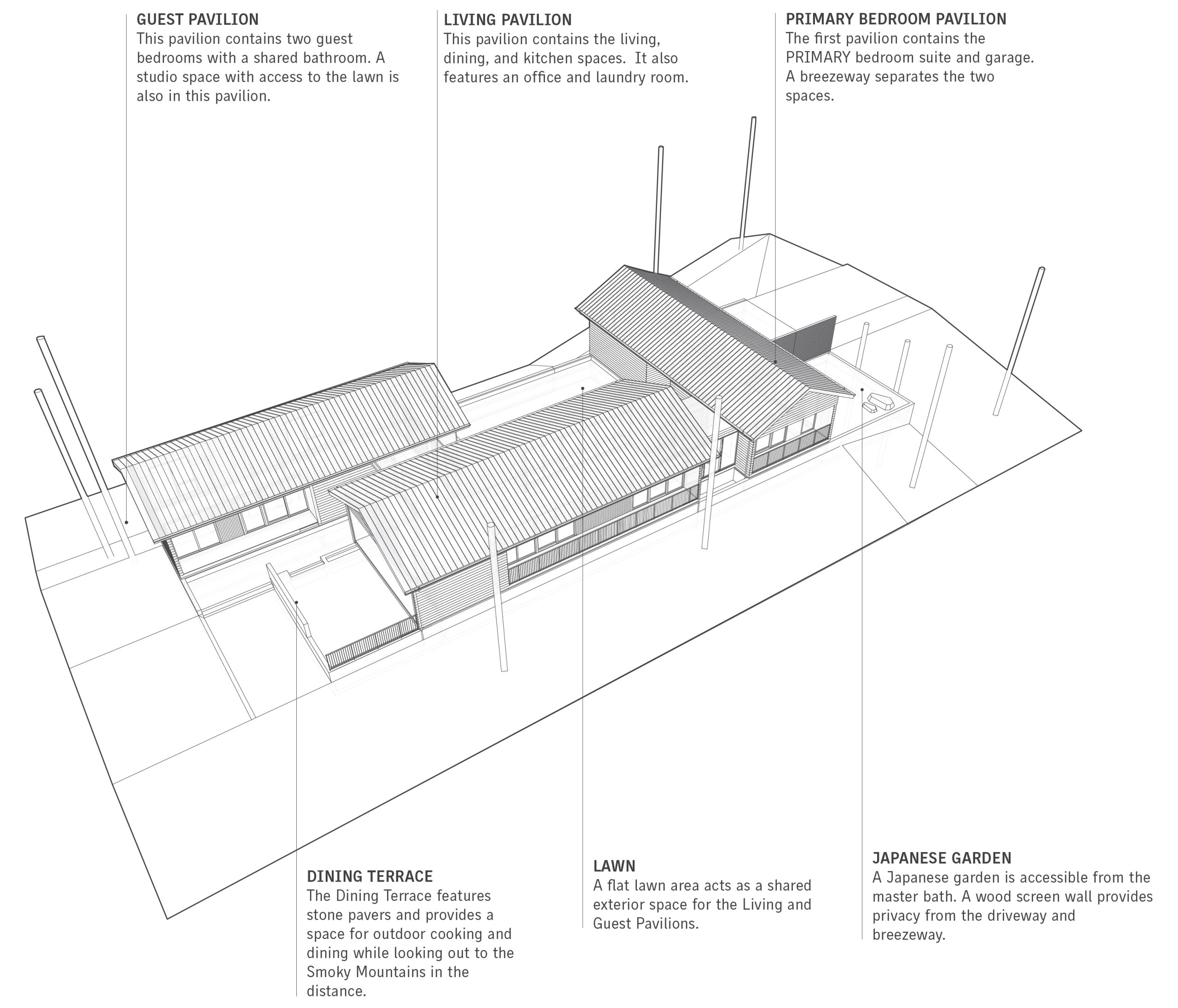
The Short Mountain House is located on a ridge in Maryville, Tennessee with panoramic views to the Great Smoky Mountains National Park. Designed for a couple with an extended out-of-town family, the house is divided into three “pavilions”. Two of these pavilions allow the house to be compartmentalized to efficiently accommodate the needs of the owners while allowing for the ability to expand into the adjacent pavilion during visits from children and grandparents. The pavilions are carefully situated to allow for clear sightlines into the park while defining a series of unique, intimate exterior spaces. The pavilions are joined by formally distinct connectors, designed as bridges spanning from one pavilion structure to the next.
While the simple gable forms reference the vernacular structures of the East Tennessee foothills, the specific roof pitch was inspired by the the forms of traditional Japanese architecture. A restrained material palette of stone veneer, wood siding, and standing seam metal roofing is utilized to allow the house blend in with its surroundings. The primary siding is Accoya with a brushed Shou Sugi Ban finish – a traditional Japanese treatment process that preserves wood by heavily charring it, rendering its surface fire retardant and resistant to rot, insects, and decay. A secondary siding material is used as an accent for inset “engawa” spaces – a defining feature of Japanese homes that consist of a covered strip of decking, often finished in wood, along the home’s periphery serving as a transition to adjacent gardens. The engawas at the Short Mountain House help control solar heat gain by providing overhangs at the large sliding glass doors at each pavilion.
The house includes a broad range of sustainable design features:
• The layout of the pavilions along the ridge was carefully studied to maintain existing large trees, maximize north/south exposure, and limit site work required for construction. The narrow floor plans of the pavilions minimized site disturbance on the north and south slopes.
• The majority of the exterior glazing is protected by the engawa overhangs to minimize heat gain during the summer months.
• Continuous exterior insulation is provided on the exterior walls of the house.
• The unvented crawlspace allows for ductwork and other systems to be installed within the thermal envelope.
• A rainwater harvesting system serves as the potable water supply for the project. The roof downspouts are routed to (3) 1700 gallon storage tanks located in the crawlspace. A water filtration system consisting of a 5-micron sediment filter, a carbon filter, and an ultra-violet disinfection system treat the water prior to entering the home.
• An electric vehicle charging station is provided in the garage.
• The landscaping strategy includes native plant species, minimizing irrigation and maintenance needs, including planting for the extensive green roofs on the connector structures spanning from one pavilion to the next.